SLL-GREEN+ (School Living Labs)

Cel programu:
SLL-GREEN+ (School Living Labs) – a model network of learning spaces and an educational programme focused on innovation in vocational education and training. Its aim is to strengthen vocational and technical education by implementing and testing a scalable School Living Lab model. The programme addresses the challenges of the green and digital transformation.
Teachers! Check out our free climate education handbook to support you in your daily work.

SLL-Green+: List of Formally Qualified Schools and Reserve List

Ogłaszamy wyniki naboru do programu SLL-Green+ (School Living Labs for Green and Digital Skills in Vocational Education). Komisja rekrutacyjna zakończyła ocenę zgłoszeń i wyłoniła szkoły partnerskie oraz 1 szkołę rezerwową, które dołączą do programu w latach 2026–2030.

The energy and climate transition is accelerating, while at the same time Poland is facing a growing skills and workforce gap – particularly in professions related to renewable energy sources, digitalisation, and environmental technologies. By 2030, there may be a shortage of up to 1 million skilled workers, including around 200,000 in the renewable energy sector (RES).
SLL-GREEN+ addresses these challenges by strengthening vocational schools as places where students learn not only a profession, but also how to design and implement innovations for the green economy. The core of the project is a comprehensive educational pathway for designing innovation, leading from problem diagnosis, through idea generation, to prototyping and testing solutions in real-life environments.

Vocational schools as centres of innovation

Within the programme, the School Living Lab model will be implemented by 2030 in 16 technical secondary schools and stage II sectoral vocational schools, in cooperation with local governments and businesses. A total of 14 new and 2 modernized model labs will be created - interdisciplinary spaces combining technical competencies (including IT, renewable energy, and automation) with environmental themes such as water, energy, space, and biodiversity.

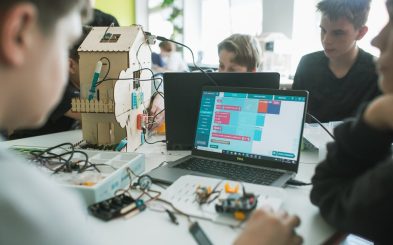
Living Labs operate based on the Code for Green® method and the innovation design process (design thinking). Working in teams, students identify local challenges, develop concepts, prototype solutions, and test them in collaboration with their surroundings—local governments, public institutions, and local businesses. As a result, schools become innovation hubs and become places where vocational education responds to real labour market needs. These will ultimately function as innovation incubators for students and teams who have the courage to challenge status quo and propose solutions that support pro-environmental and pro-climate attitudes.

Every year 320 students from technical secondary schools and stage II sectoral vocational schools will participate in regular Living Lab sessions, working on real environmental and technological challenges. The most promising teams will present their ideas at nationwide hackathons,and selected projects will receive microgrants and incubation support, enabling pilot implementation and further development of their solutions.

At the same time, the programme strengthens vocational education staff. A total of 32 teachers and 16 school will undergo training in the Code for Green® methodology and subsequently develop their competencies through practical work with students. A nationwide mentoring system, implemented in cooperation with higher education institutions, will provide expert support and ensure a continuous link between education and current technological and market challenges.

SLL-GREEN+ is not only an educational programme, but also a tool for driving systemic change.Through cooperation with business, the model responds to the real needs of local and regional labour markets, and vocational schools gain a new role: hubs for developing skills and solutions for a green, resource-efficient economy.SLL-GREEN+ aligns with the strategy of the Code for Green Foundation, which focuses on creating educational models designed for large-scaleimplementation rather than one-off projects.

2026

Start of programme implementation

Start year: establishment of teams, recruitment and selection of 16 partner schools (one from each voivodeship). Equipping and launching 16 School Living Lab classrooms. Production and publication of 10 e-courses on the LMS platform. First workshops for teachers and school principals.

2027

Start of student cycles

Launch of weekly project-based classes in 16 schools (minimum 20 students per school). Start of mentoring with experts from universities and business (minimum 400 hours per year). First Demo Day – presentations of student projects. Round table with environmental funding institutions.

2028

Hackatons

First nationwide SLL-Green+ Hackathon with participation of students from all 16 schools. Launch of incubation and micro-grants for the best projects (minimum 5 teams).

2029

Scaling and implementation

Continuation of student cycles with strengthened project quality assessment. Pilots of local solutions in cooperation with local governments and businesses. Update of the Funding Map and preparation of a replication package of the model for further schools in Poland.

2030

Final phase and open access

Final Hackathon and showcase of the entire SLL-Green+ model. Publication of an open-access package: methodology, lesson scenarios, e-courses, and evaluation tools made freely available to all vocational schools in Poland.

Contact us. Let's talk
Marta Zwolińska-Budniok

Programme Manager

Would you like to co-create a new model of vocational education in Poland? Contact us.

Become an expert or local partner of the SLL-Green+ programme.

We are an organization focused on action!

See what children have achieved through our projects – students have created around 100 different prototypes, some of which have been implemented. Read also about our other achievements.

How can you help?

By supporting our foundation, you help equip children with the tools and knowledge to design solutions for their local environmental problems, thereby contributing to the fight for a better future for the world.

Wpłat można dokonywać na konto:
Fundacja Code For Green
Buda Ruska 19 c, 16 -503 Krasnopol
45 1050 1953 1000 0090 8038 6932

W tytule przelewu prosimy wpisać: darowizna na cele statutowe

How can you help?

By supporting our foundation, you help equip children with the tools and knowledge to design solutions for their local environmental problems, thereby contributing to the fight for a better future for the world.

Due every month

News
SLL_1
School Living Lab-Green+ launches in all 16 Polish regions: a new dimension of vocational education
GSN_MOchwat
Systemic education is the missing link in climate security
Kopia – posty poziome - 2
SLL-Green+ Programme Selection Results: Meet Our Partner Schools!
Gain new knowledge. Sign up!
Jeśli tak, dołącz do naszej społecznosci i otrzymuj informacje o naszych nowych webinariach, podcastach, artykułach, raportach i szkoleniach. Niektóre z nich są dostępne wyłącznie dla członków newslettera!
Project Partners
Partnerzy merytoryczni

Patroni medialni

Funded by