Between 2015 and 2023, Poland’s renewable freshwater resources per capita ranged from 1,100 to 1,600 cubic metres per year. The water security threshold set by the United Nations is 1,700 cubic metres per person. Poland regularly falls below this level. In terms of freshwater availability per capita, Poland ranks third from the bottom in the European Union, ahead of only Cyprus and Malta. The European average is nearly 4,500 cubic metres per person — almost three times more than in Poland.
These are not figures from distant projections. They paint a picture of Poland today, as described in this year’s GUS report, Poland on the Path to Sustainable Development. SDG Report 2025.
This picture needs one more fact: between 2019 and 2024, more than 3,200 surface water bodies — rivers and reservoirs — in the Vistula and Oder river basins were assessed. Only 49 of them, or 1.6%, achieved good ecological status. The chemical status was unsatisfactory in 86% of the water bodies assessed. Poland’s water problem is not an abstraction.
Knowledge without action
The paradox of environmental education in Poland is that we know a lot and do too little. Studies on Poles’ environmental awareness consistently point to a high level of theoretical knowledge alongside a low readiness to change behaviour. The report Students on Climate Change showed that climate issues are important to nearly 70% of students, yet only 17% actively participate in climate action. As Professor Bernadetta Niesporek-Szamburska of the University of Silesia comments: “These data show that all forms of climate education are desperately needed, especially those that can lead to a change in young people’s attitudes.”
The problem lies in the method. The Polish model of environmental education relies mainly on the transmission of knowledge, and it is effective in that role. Its weakness becomes apparent when it comes to shaping attitudes and developing the skills needed to take action.Experts consistently emphasize that effective environmental education is not just about knowledge of nature, but about developing attitudes that shape real-life decisions and behaviour. And attitudes are changed through experience, not through lectures or learning from textbooks.
It is precisely this gap between knowledge and real-world action that provides the starting point for our Code for Blue programme.
Students as Agents of Change
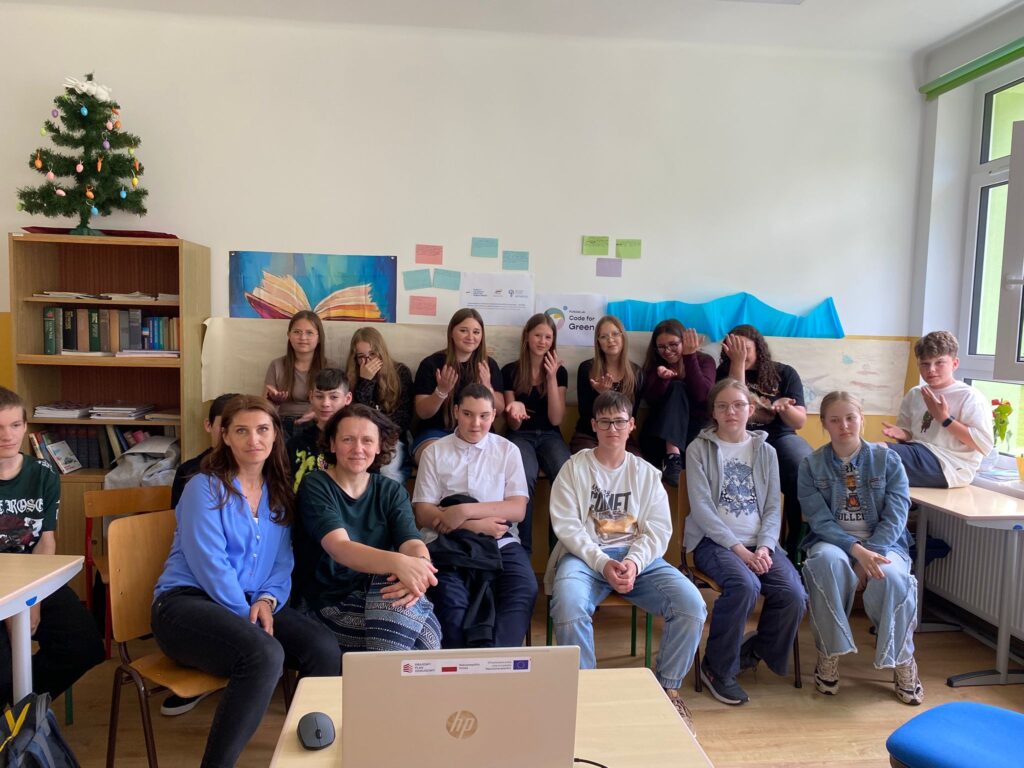
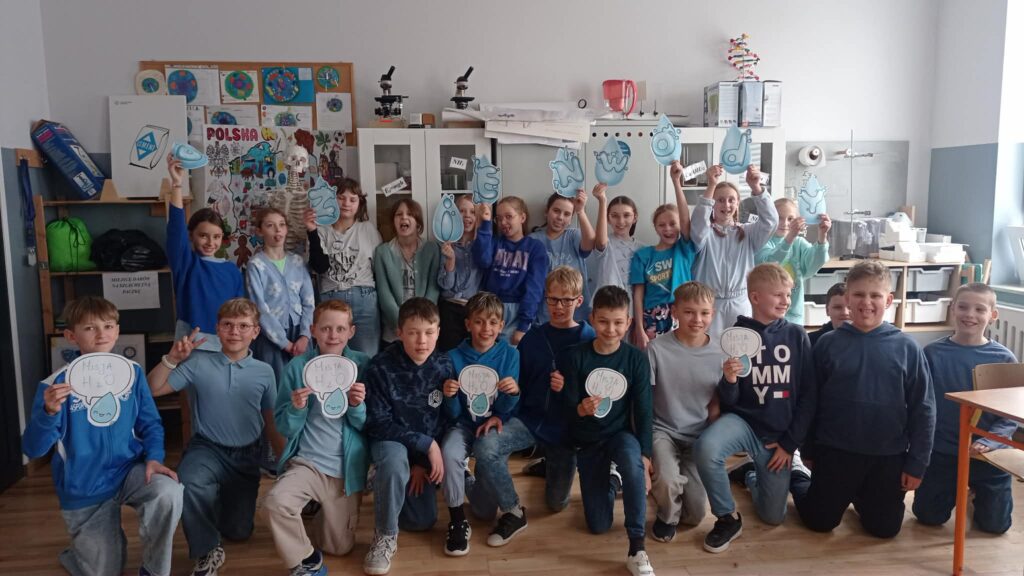
Code for Blue is an educational programme run by the Code for Green Foundation during the 2025/26 school year in 25 schools across Poland, including primary schools, general secondary schools and technical schools. Approximately 500 students took part in the programme. It was funded by the National Freedom Institute under the NOWE FIO programme, Canpack, and the Rothschild Foundation.
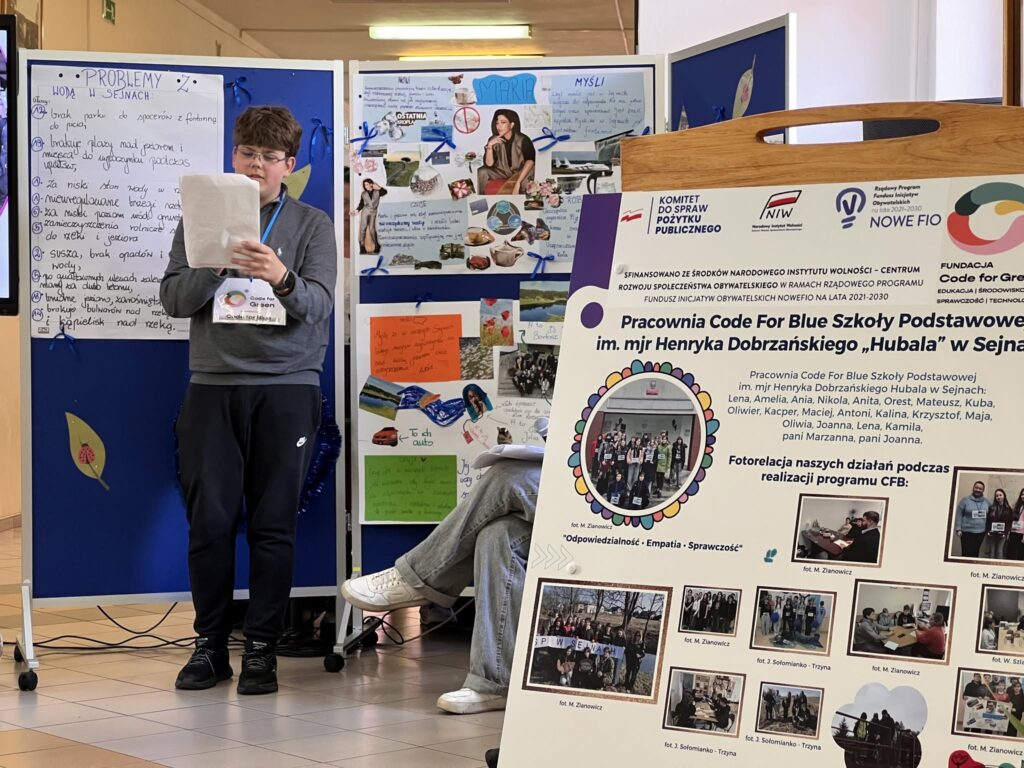
The starting point for all the activities was the documentary To the Last Drop, directed by Ewa Ewart — a report on the global water crisis that resonated with students precisely because it does not focus on distant places, but on mechanisms that operate everywhere, including here. After watching the film, students went into the field: to rivers, lakes and ponds in their local areas. They met with local government officials, senior citizens, experts from the Sanitary Inspectorate, the Polish Waters authority, universities and water utilities. First, they diagnosed local water-resource problems and then, using the design thinking method, designed and implemented solutions.
What did the students build?
The scope and diversity of the projects developed as part of Code for Blue are rarely seen in Polish formal education. These were not class assignments or presentations, but rather real interventions in the local environment.
At CKZiU “Elektryk” in Nowa Sól, students students investigated the decline of natural nesting sites for waterfowl in the urban landscape of the Czarna Struga River. They built floating nesting platforms for ducks from recycled materials, tested their stability, and placed them on the river.
In Rumia, students from Primary School No. 6 built an autonomous monitoring station on the Zagórska Struga. This urban stream had no monitoring system until now. The station measures water levels and chemical composition in real time, with data accessible via a QR code placed by the river. It is the first citizen-led monitoring system of its kind in the history of the river.
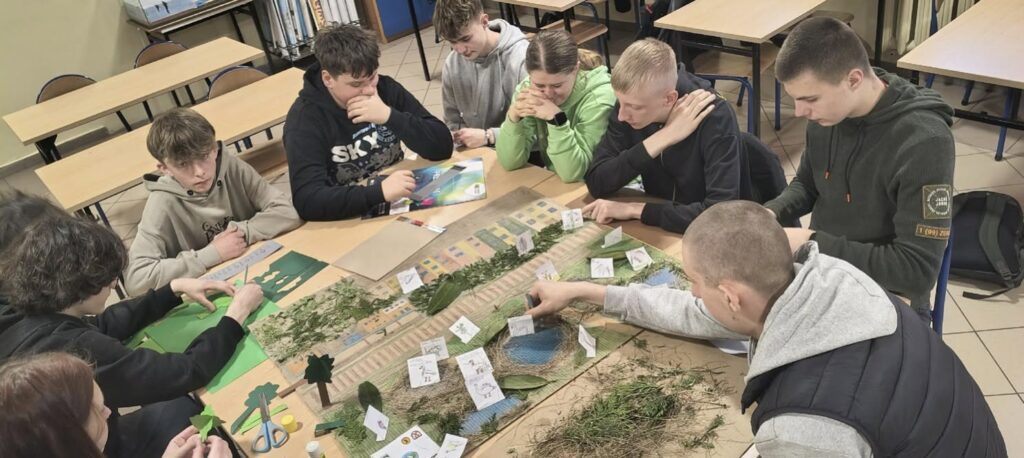
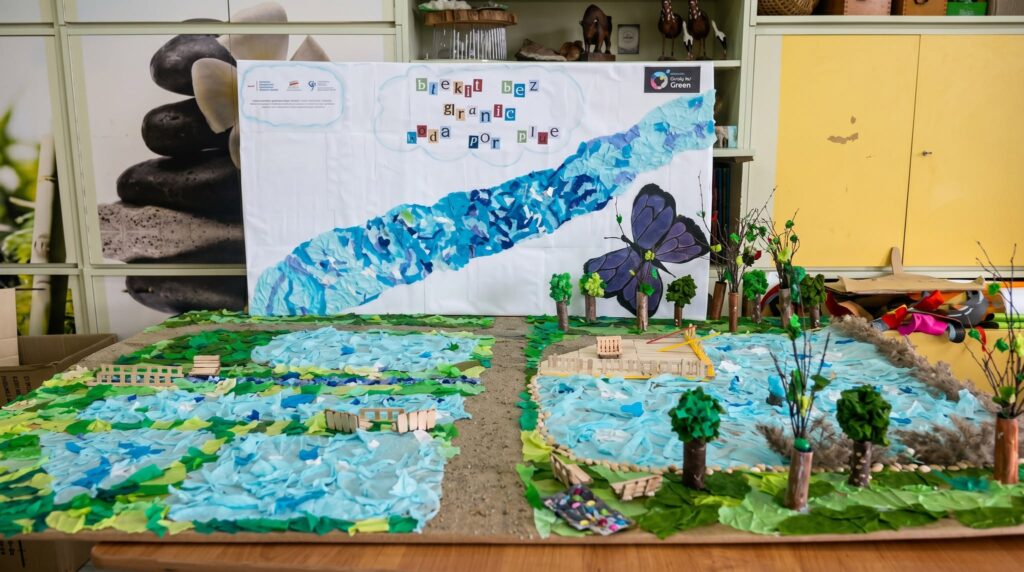
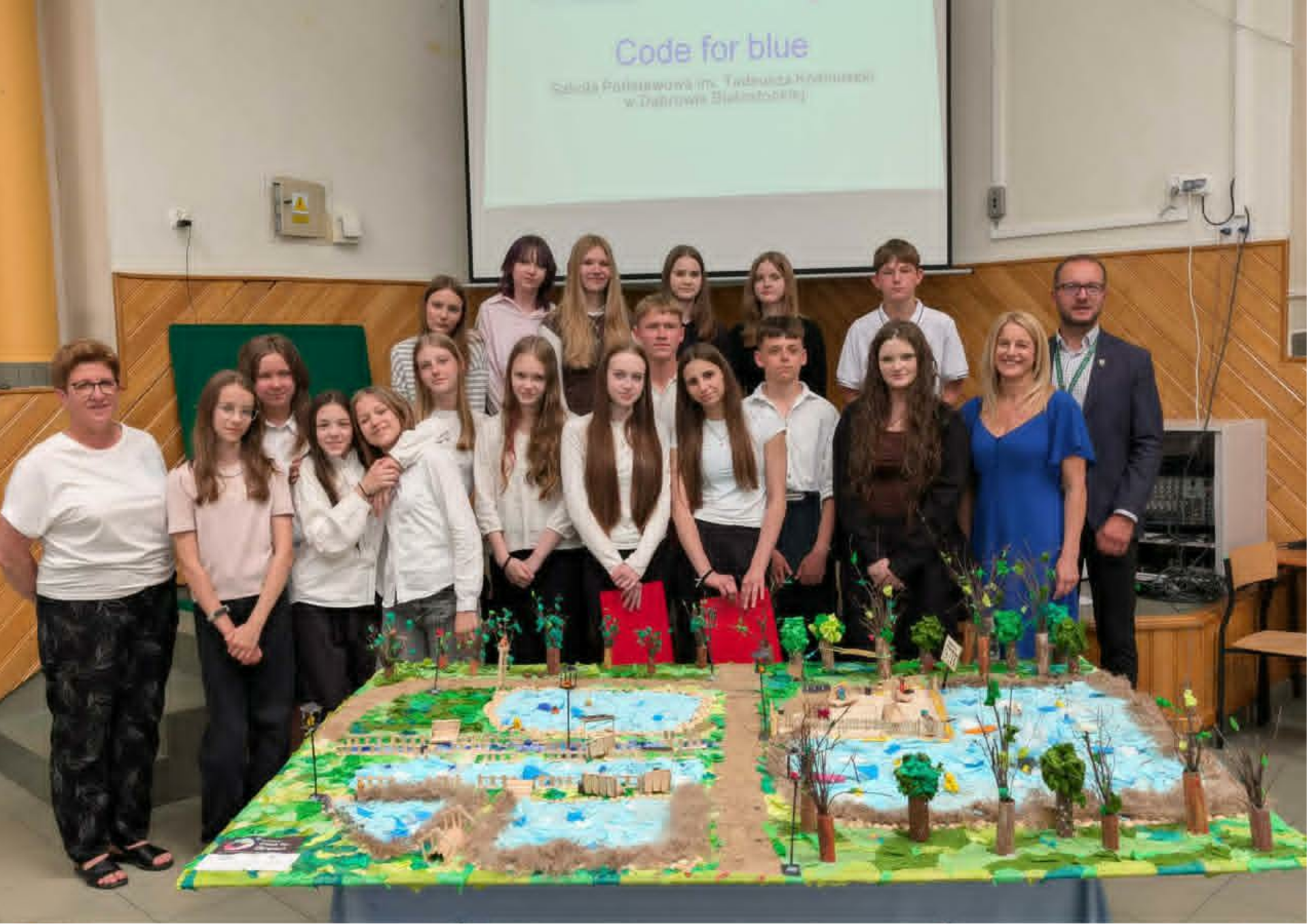
In Dąbrowa Białostocka, seventh-grade students from Tadeusz Kościuszko Primary School designed a revitalization plan for “Kalna,” a forgotten area by the Kropiwna River that had served as a center of community life since the 17th century but is now falling into disrepair. The students conducted exploratory walks, spoke with seniors at the Senior+ Club, and discovered a forgotten natural spring in one of the ponds. They built a 3D model of the proposed new space, featuring a swimming area, jetties, walking paths, and a retention zone. They presented the model to the mayor and the Municipal Council as a basis for potential changes within the limits of the municipal budget.
In Suwalki students from II General Podhorski High School installed a toilet system with an integrated sink that reuses so-called greywater — water from handwashing — to fill the toilet cistern (a system often referred to as a “Japanese toilet”). They conducted measurements over eight days. The result: more than 190 litres of clean water saved per week in a single toilet at one school. Scaled up to thousands of schools across Poland, the potential savings are striking.
In Kluczbork, students from the Licealno-Techniczny School Complex investigated the water chemistry of Kościuszko PondTwo series of tests — conducted in winter and spring in cooperation with the local Sanitary and Epidemiological Station — revealed elevated levels of phosphates, nitrates, and iron. Based on these findings, the students designed an ecological floating filtration island using aquatic plants to absorb excess nutrients from the water. The project was presented to the mayor.
In Janowice, students from the local Primary School working in cooperation with the Forest District and the municipality, planted trees along the Lubianka River, restoring part of a riparian forest. A riparian forest — essentially, “trees growing alongside water” — is a form of natural infrastructure that slows water runoff after rainfall, stabilizes riverbanks, stores water in the soil, and helps protect against flooding. Before planting, the students conducted field measurements of the river’s flow and analyzed the soil composition, seeking to determine which type of soil was better at retaining water.
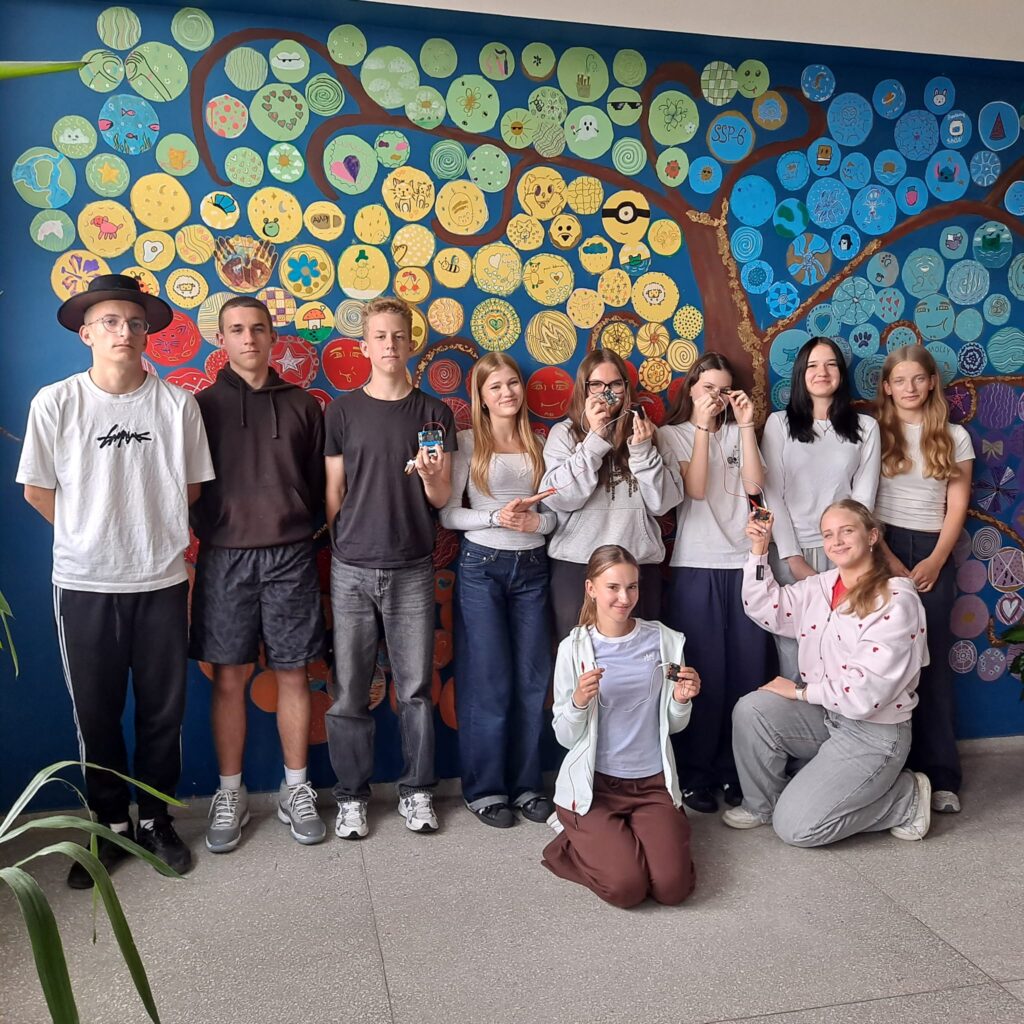
In Września, students from Municipal Primary School No. 6 programmed soil moisture sensors using the micro:bit platform for the school’s educational garden. One of the systems was literally built using nails, insulated so that soil moisture could be measured independently at different depths.
The next three projects show that students also turned to significantly more advanced technologies.
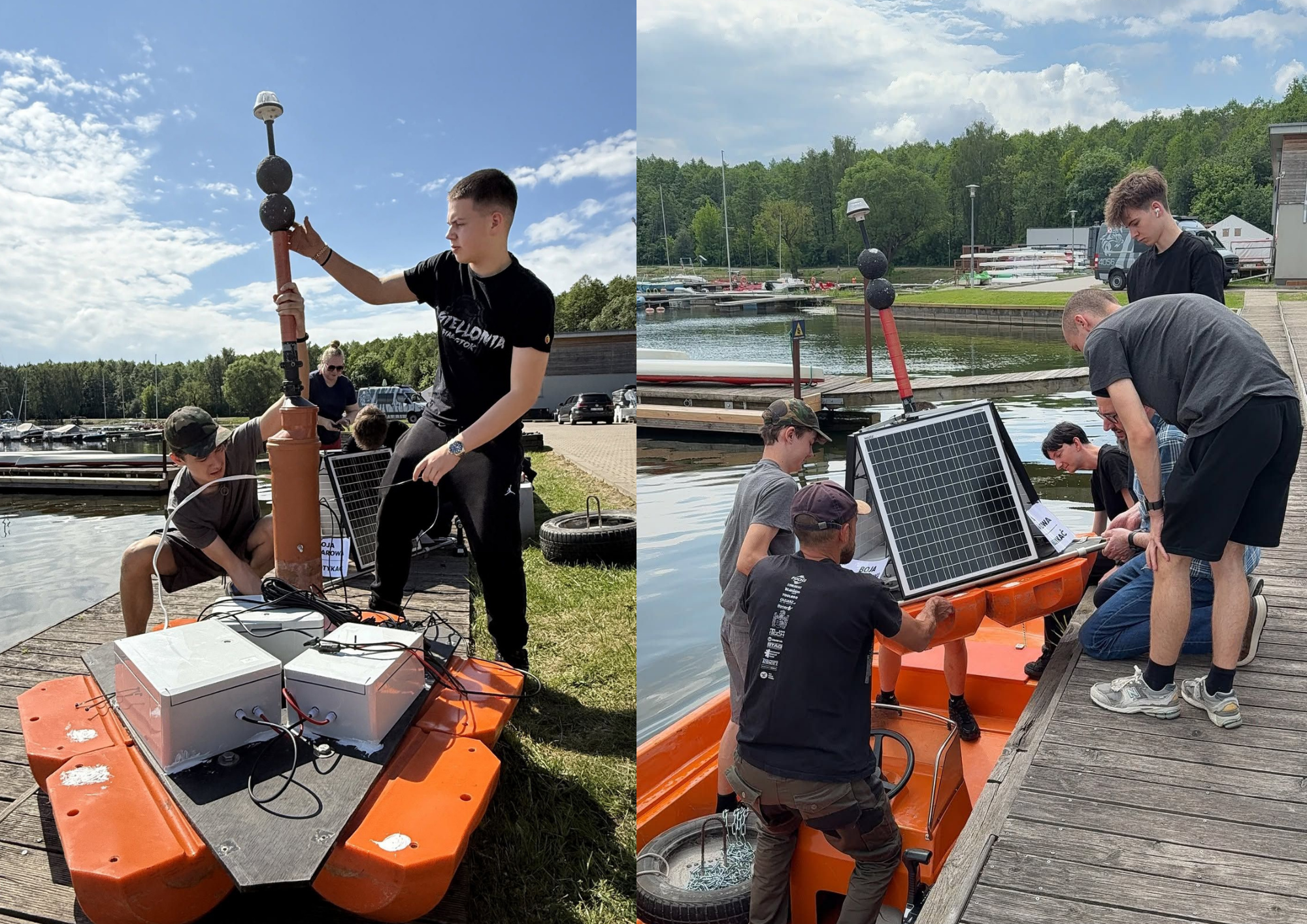
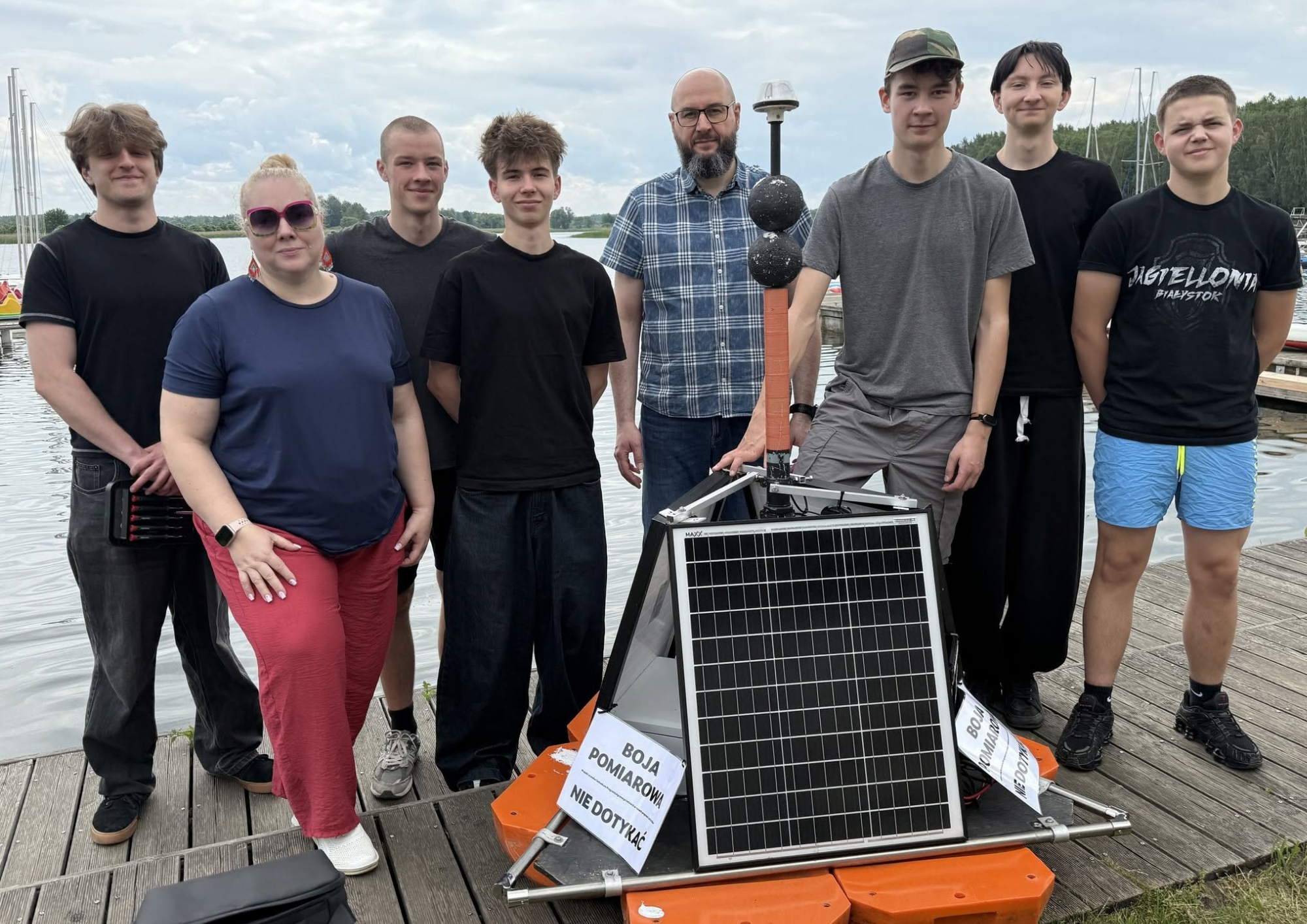
In Bialystok, students from Infotech Programming Technical School went a step further than the river monitoring station. At Dojlidy Reservoir, the region’s largest swimming area, visited by more than 100,000 people each year, they built and anchored an autonomous monitoring buoy powered by solar panels. The buoy continuously measures four water parameters, 24 hours a day: temperature, pH, electrical conductivity, and dissolved oxygen levels. The data is transmitted via a GSM network to a server and is publicly available at iot.infotech.edu.pl/bojka The data is presented as clear, easy-to-read graphs with explanations. If any parameter exceeds the permitted threshold, the system automatically sends an SMS or email alert to the swimming area manager. Every two weeks, the students go out onto the reservoir to clean the sensors of accumulating sediment. The project was born from a simple observation: the swimming area is sometimes closed because of oxygen depletion — a sudden drop in the water’s oxygen levels that can be predicted if the parameters are monitored regularly. Until now, no one had been doing this. Now the students are.
In Zabrze, students from Primary School No. 31 tackled a problem that seems trivial but is surprisingly difficult to solve: no one at school responds to taps being left running or leaking. Their diagnosis — interviews with school staff, a simulation game for students, and a survey involving all school groups — confirmed it clearly: people notice a running tap, but do not feel responsible for doing anything about it. Their response was AquaAlert, a sensor based on the principle “I see it, I hear it — I respond.” It detects when a tap has been left running for longer than a set period and sends a reminder signal to turn it off. The students built a working prototype and obtained permission from the school administration to implement it at the school. Unlike posters, this is a solution that does not appeal to people’s awareness. It simply works, regardless of the user’s willingness to act.
A method that turns knowledge into practical action
Behind this diversity lies one common methodological framework: the original educational programme developed by the Code For Green Foundation. Students began with empathy — stepping into the perspective of specific people (seniors, anglers, residents at risk of flooding, and swimming area users), rather than starting with a predetermined thesis to prove. Only after understanding the problem did they move on to defining it, generating ideas, building prototypes, and testing them.
This approach is strongly supported by research on the effectiveness of environmental education. Experts from the Jagiellonian Club, in their analysis of environmental education in Poland, state explicitly: “Limited effectiveness in education when it comes to building appropriate motivation stems from the fact that the Polish teaching model does not sufficiently account for the role of engaging emotions, which enable proactive action.” Design thinking, place-based education, and learning through action — the methods used in Code for Blue — are a direct response to precisely this gap.
Students learned not only about water but also developed practical interpersonal skills — how to talk to a mayor, conduct a research interview, design something that actually has to work, and defend their ideas before experts. These are skills no textbook can provide.
Local means global
The Code for Blue programme is being implemented at a time when water resource management in Poland is no longer an issue concerned solely with the environment and discussed by a narrow circle of experts. Satellite analysis of data from 2002–2024, conducted by scientists at University College London and published in late 2025, identifies Poland among the European areas at risk of progressive drying. The level of small-scale water retention in Poland is around 6 percent, compared with more than 40 percent in Spain. The government’s Water Retention Development Programme aims to increase this figure to 15 percent by 2027. There is still a long way to go.
In this context, the students’ projects take on a different dimension. The rain garden at the boarding school in Dąbrowa Białostocka, the riparian forest along the Lubianka River, and the pond in Kluczbork restored through biological filtration are no longer simply school projects. They are small-scale, local implementations of precisely the principles that Poland’s water policy is expected to put into practice at a systemic level: increasing water retention, restoring natural water infrastructure, monitoring water quality, and raising public awareness.
The difference is that the students did not stop at plans and discussions about possible solutions — they actually implemented them.
Program Code for Blue jest realizowany przez Fundację Code for Green dzięki wsparciu programu NOWE FIO (Narodowy Instytut Wolności – Centrum Rozwoju Społeczeństwa Obywatelskiego), firmy Canpack oraz fundacji Rothschild. Dane hydrologiczne i środowiskowe pochodzą z raportu GUS „Polska na drodze zrównoważonego rozwoju. Raport SDG 2025” oraz z analiz Europejskiej Agencji Środowiska i University College London.
Partner programu Code For Blue: